
Tuesday, October 24, 2006



Thursday, October 05, 2006
No More Fishing in Malësia

Nutritionists say that fish is “brain food,” that by consuming small portions at least once a week it increases one’s memory significantly. As a result, it would be fitting that fish be a required dietary alternative for those who experience short-term memory loss. This assertion can be safely attributed to Montenegro’s outgoing Premier, Milo Djukanovic, who for the past decade has seemed to forget the promises he made to Malësia, promises that he hoped Albanians would also forget.
Let us not forget that it was our popularly-elected Milo that promised Malësia the fruits of fortune, progress, stability and proliferation in 1997; it was Milo that pledged to Malësia comprehensive forms of self-determination and self-representation in 2002; it was Milo that assured Malësia enhanced minority rights, economic development, political accommodation, civic-ness and civility in 2004; and who can forget when in 2006 Milo promised Malësia the world by granting her an autonomous Commune with all the benefits of the previous 21 before her?? Promises they were, realities they were not.
In fact Malësia should not forget any time soon, because like any good Fisherman you have to attach the right bait on a fishing line, throw it out into the waters and wait for something to bite. Milo proved to be a Master Fisherman – for the bait he chose to cast into the waters of Malësia from 1997-2007 fetched him a lot of quality fish; and with every new season Milo would select his bait carefully so he would have enough to show the international community that the fish in Malësia bite every time he throws bait their way.
But something strange happened in September 2006: The fish stopped biting. Perhaps they got sick of the same bait, or was it the same lies? The fish craved a new flavor, something that would keep their bellies full without getting them hooked and taken away from their autonomous waters; perhaps the fish decided to eat from their own territory and not swim outside their boundaries where danger always persisted, where so many of them were caught and eaten, often depleting the waters of the best and tastiest fish of them all.
This scared Milo, because no fish means no power, and no power in the Balkans means the start to a political downfall. Even with the fish he caught in the past, problems will come to light. We know what happens to fish out of water, they flip, twist and jump frantically until they are let back into their environment, and by keeping them locked up for too long, they attract a foul smell that will poison anyone that dares to taste it. Milo understands that the 15 fish he is keeping locked up in Podgorica will eventually destroy him, and the only way to prevent harm is to let them back into their waters.
Today we see “No Fishing” signs all over Malësia; not because the fish are no good, but because it is time to remind the new Fisherman that the waters of Malësia are forbidden for fishing anymore, and those that dare to cast a line into her waters will be pulled in and drowned!
The Old Man from Malësia
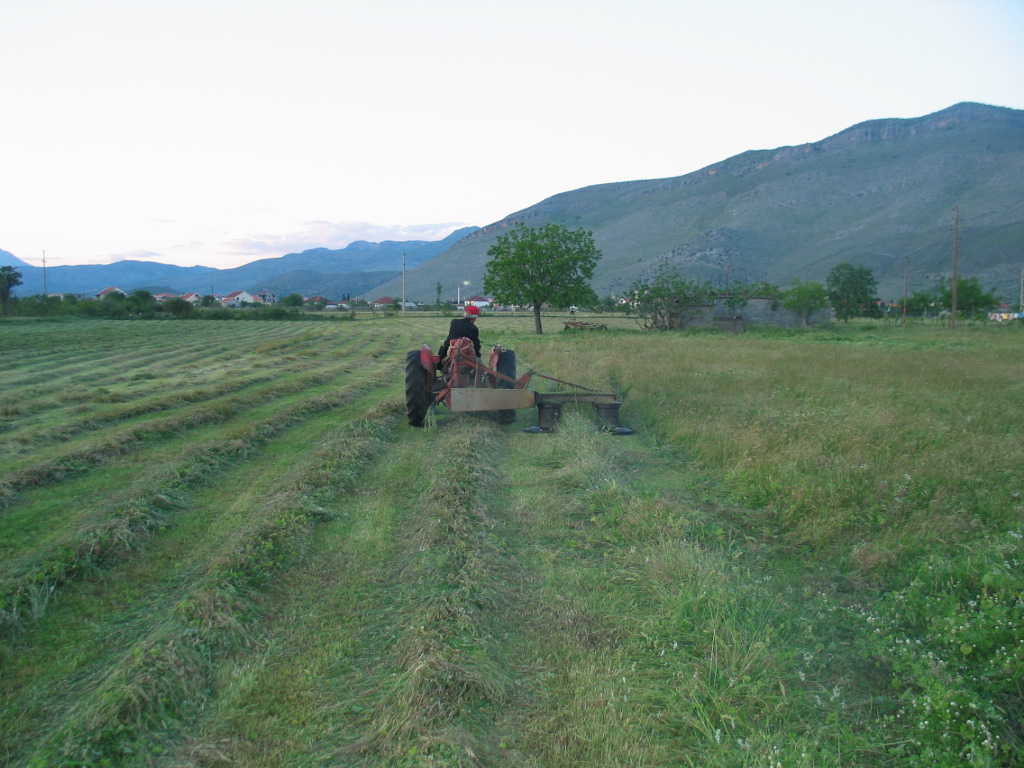
An old Albanian lives in Malësia close to Tuz. He would love to plant potatoes in his garden, but he is old and weak. His son is in college in Detroit, so the old man calls him on his cell phone.
"Beloved son, I am very sad, because I can't plant potatoes in my garden. I am sure if you were here you would help me dig up the garden."
The following day, the old man receives a voice-mail message from His son at 3:45 p.m.:
"Beloved father, please don't touch the Garden. It's there that I have hidden ‘the THING’, Love Besnik".
At 4:02 p.m., the Montenegrin police, along with the special anti-terrorist unit, UDB-a, and the national army, visit the house of the old man, take the whole garden apart, search every inch, but can't find anything. Disappointed they leave.
A day later, the old man receives another voice-mail message from his son:
"Beloved father, I hope the garden is dug up by now and you can plant your potatoes. That's all I could do for you from here, Love Besnik."
Wednesday, October 04, 2006
Djukanovic Resigns, But Corruption Continues
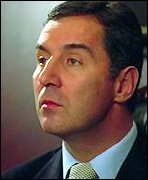
Montenegrin Prime Minister Milo Djukanovic declared Tuesday that he will resign his post despite his coalition's victory in last months parliamentary elections.
Although President Filip Vujanovic stated that Djukanovic is resigning for "personal reasons" many believe that his decision to leave after 15 years in power is largely due to the growing unrest surrounding the Albanian region of Malesia and the failure to bring unity and cohesion between ethnic and religious groups in Montenegro.
His record as President and Prime Minister has been plagued with problems since he took office. In Italy prosecutors are still investigating allegations that Djukanovic was a ring-leader in a multi-million dollar cigarette smuggling racket. This stemmed when in 2002 the European Union accused tobacco giant R.J. Reynolds in a lawsuit of selling black-market cigarettes to drug traffickers and mobsters, helping them launder profits from their illegal activities.
Among the other allegations in the lawsuit, RJR moved its cigarettes through the Balkans in the 1990s by means of illicit payments to corrupt government officials, including Milo Djukanovic, and the deceased former head of the Montenegro's Foreign Investment Agency, Milutin Lalic.
The suit said payments came from a company founded by Italian organized crime figures that had the official sanction of the investment agency and operated under the protection of Djukanovic. The company, Montenegrin Tabak Transit, was granted exclusive rights to move cigarettes through the Port of Montenegro, and over time made millions of dollars in payments to members of the Yugoslav federal government and Montenegrin regional governments, including Djukanovic and Lilic, the lawsuit states.
It says RJR executives and distributors were well aware that such "licensing fees" were being paid to facilitate the movement of their brands. They "traveled to Montenegro on a regular basis to inspect their cigarettes and service their customers and, as such, were well aware of these practices," the lawsuit states.
According to European press reports, Italian authorities had opened a criminal investigation into alleged involvement by Djukanovic with Mafia-run smuggling operations.
Also suspect is his quick rise to fortune, where Djukanovic and everyone close to him have become suspiciously rich over the years. Since he took office, Montenegro bacame a haven for tycoons wishing to launder money through fraudulant banks where anyone with $10,000 could create their own bank and funnel bogus money without undergoing verification checks.
In Montenegro you can create your own offshore bank for only $9,999, in eight weeks or less and without a background check.
The offshore status of the banks means their foreign owners benefit from tax breaks, exemption from currency controls and confidentiality (Wired News).
Senate investigators (including Carl Levin of Michigan who in 2001 spoke on this behalf in a Senate committee hearing) who say many large U.S. banks have unwittingly become conduits for dirty foreign money, see the ads as a new money-laundering danger because the "personal" banks may offer links to accounts at American institutions.
The new banks licensed by Montenegro, for example, are touted as offering correspondent accounts at the national Bank of Montenegro, which in turn is said to have accounts with major banks in Switzerland and other countries.
Today Djukanovic is facing growing pressure from ethnic Albanians in the Malesia region, who deamnd he pay more attention to minority rights and adhere to appeals for greater self-representation in all spheres of life. The arrests of Albanians made last month in Tuz also triggered an outcry from Albanians in the Diaspora calling for Djukanovic to step down after Albanians were rounded up, beaten and tortured just 24 hours before national and local elections were to take place. Many still believe that these actions were politically motivated to scare Albanians from participating in those elections.
Sunday, October 01, 2006
Terrorism From Above

This masked gunman participated in the violent raids in the Albanian-dominant region of Malesia where he and dozens of other policemen viciously beat, arrested and tortured numerous Albanians for alleged acts of terror. To this day no evidence has linked any of those arrested to any crimes, however the abuses continue inside the prison walls and in the villages surrounding Tuz, where daily life has changed considerably. Fear of state suppression is once again making a comeback in this former Yugoslav republic, which has minorities fearing that the independent Montenegro that they voted for has turned the tables against them.
These were the same units that operated under Slobodan Milosevic during the wars with Croatia, Bosnia and parts of Kosova, which left thousands dead and many more displaced. Today Montenegro has created an atmosphere that is damaging inter-ethnic relations, something that has plagued the Balkans for the past 15 years and now continues via the political apparatus in Podgorica.
Podgorica's control of all media outlets has enabled these illegal interrogations to proceed unchallenged, given that any media detractors willing to challenge the legitimacy of the arrests will either be permanently shut down or arrested for "treason."
Moreover, because Montenegro does not have an independent judiciary, one that repects the rule of law in the domestic and international realm, the chances that those being held in jail to receive a fair and speedy trial is nullified. Any and all evidence brought before them, however fabricated it will be, will not be dismissed but used to levy the harshest penalties available. This is an incredulous contradiction to the postulates of democracy and democratic transition. It is imperative that a state claiming to practice democratic traditions and appealing to join the family of Europe must also exercise an independent judiciary that has no influence from other state institutions (ie, Parliament, PM, etc.). This is not the case in Montenegro; what we have in Podgorica is a parallel government that shadows that of Belgrade during the era of the communist party.
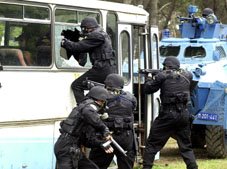
State terrorism thus is nothing new in Montenegro. Its hold on the Albanian minority population through oppressive and fear tactics is crucial for them. Over the past several months Albanian nationalism has finally made its way from Kosova to Malesia, evidenced by the unified campaigns to elect members of local parties and oust those that have hindered their progress and development. This show of force has caught the attention of Podgorica and has caused discomfort in Djukanovic's party; the fear of an Albanian (political and social) uprising where the several regions of Malesia e Madhe would socially, ideologically and politically unite would spell trouble in the eyes of Montenegrins. The prospect of an "Ethnic Albania" has caused many sleepless nights in Podgorica, and those prospects drew a bit closer on September 10th when Albanians catapulted their own representatives into Parliament and local offices for the first time ever.
What is important now is to see how Podgorica handles two issues, (1) the victory of Albanians in Malesia with representatives in Parliament and in the urban municipality, and (2) the handling of the prisoners. International pressure on the latter will continue to mount, and Podgorica must be very careful on how they act during their "face-saving" plans.
Subscribe to:
Posts (Atom)